
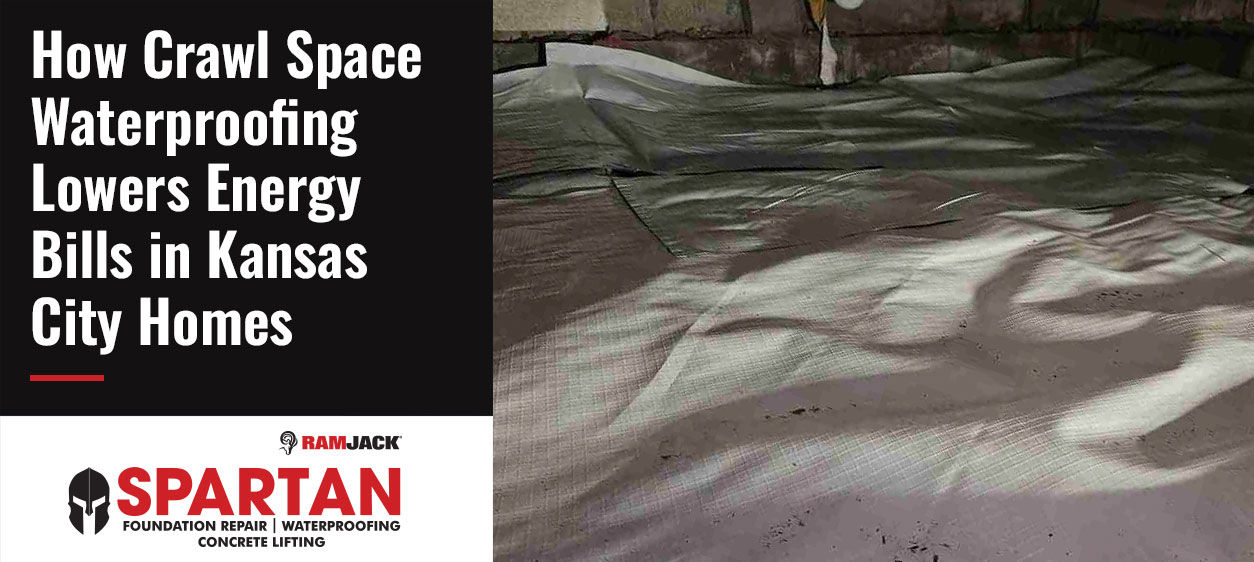
Your monthly energy bills might be climbing not because of your HVAC system, but because of what’s happening beneath your floors. The relationship between energy bills and crawl space waterproofing Kansas City are connected, as unsealed, moisture-laden crawl spaces force heating and cooling systems to work overtime. Humid air from below rises into your living areas through the stack effect, so it becomes harder to maintain comfortable temperatures.
Crawl space encapsulation energy savings become possible when you seal out moisture with a vapor barrier and proper air sealing and drainage. This approach can reduce energy bills crawl space issues cause by eliminating crawl space moisture and HVAC efficiency problems. Most homeowners see a return of 50% to 80% of the cost at resale. It also protects your system and stabilizes indoor comfort year-round by addressing HVAC strain humid crawl space conditions create.
Quick Answer: How Crawl Space Waterproofing Affects Energy Bills
Crawl space waterproofing cuts energy bills for Kansas City homes once you address the root cause: uncontrolled air movement between your crawl space and living areas. The mechanism behind this problem is straightforward and measurable.
Stack effect: humid air rising from crawl space into living areas
Your home functions like a chimney. Warm air rises through your upper levels and escapes through attic vents, windows, and gaps in your ceiling. That air exits and creates negative pressure that pulls replacement air from the lowest point in your structure. Your crawl space is that lowest point. Up to 50% of the air you breathe on your first floor can originate from your crawl space. Moisture, mold spores, and musty odors in that space move straight into your bedrooms and kitchen. Kansas City humidity levels magnify this problem during summer months. Hot, moisture-laden outdoor air enters through foundation vents and gets drawn upward into your conditioned living space.
HVAC systems working harder to manage indoor temperature and humidity
Excess crawl space moisture and HVAC efficiency are inversely related. Humid air feels warmer in summer and cooler in winter. Your system runs longer cycles to reach your thermostat setting. Your ductwork sits in a damp crawl space, and conditioned air leaks out before reaching your rooms. Your equipment compensates by working harder, which increases strain on compressors and blowers. Studies indicate that encapsulated crawl spaces can reduce energy consumption by up to 20%. The Environmental Protection Agency reports average heating and cooling savings of 15% after proper insulation and encapsulation. Some homeowners in hot-humid climates see HVAC-related energy cost reductions between 15% and 30% after switching from vented to encapsulated crawl spaces.
Waterproofing and encapsulation seal moisture out, reducing HVAC strain
Crawl space encapsulation energy savings become possible once you install a vapor barrier crawl space system across your floor and walls, seal foundation vents, and add a dehumidifier. This approach stops outdoor air infiltration that forces HVAC systems to work harder. Sealing the crawl space brings it into a consistent thermal envelope and reduces temperature differences between your crawl space and first floor. Your heating and cooling equipment then maintains balanced humidity, improves airflow consistency, and extends its operational lifespan.
Why Wet Crawl Spaces Drive Up Energy Bills in Kansas City
Kansas City’s climate creates ideal conditions for crawl space problems that directly affect your heating and cooling expenses. These regional factors explain why crawl space waterproofing Kansas City homeowners invest in delivers measurable utility bill savings home sealing provides.
Kansas City humidity levels and seasonal rainfall patterns
Kansas City receives 40 inches of precipitation each year, with May averaging 5 inches as the wettest month. Relative humidity ranges from 69% to 82% throughout the year. Dew points climb above 65°F from July to August, and the air feels uncomfortably humid. Vented foundations act like humidifiers at the time outdoor dew points exceed your crawl space temperature. They deposit moisture beneath your home that your HVAC system must later remove.
Clay soil and poor drainage common in the KC metro
Clay soil dominates the Kansas City metro area. This soil type retains water and drains poorly. Persistent moisture pressure builds against foundation walls. Water migrates into crawl spaces more readily than in regions with sandy or loamy soil as a result.
How humid air rising into living spaces makes HVAC work harder
Humid air feels warmer in summer and cooler in winter. Your HVAC runs longer cycles to reach comfort levels. Your air conditioner spends 20-30% of its capacity on dehumidification instead of cooling at the time vented crawl spaces allow humid outdoor air to enter and rise into living areas. Compressors face continuous strain from this moisture load, and system efficiency drops.
Heat loss and gain through unsealed crawl space floors
Cold outdoor air infiltrates crawl space walls and floor assemblies without insulation. Warm air from your living space escapes through the floor. Rooms feel chilly and temperatures become uneven. The process reverses in summer as heat transfers upward into conditioned spaces.
Ductwork in crawl spaces reduces HVAC efficiency
Homes average more than 300 cubic feet per minute of duct leakage. Leaky or uninsulated ductwork running through crawl spaces loses 20-30% of total conditioned airflow before reaching your rooms.
Percentage of home energy loss from crawl space air leakage
DOE research documents 10-30% heating and cooling energy loss from unsealed crawl spaces. Unconditioned crawl spaces contribute 15-25% of total home energy loss through combined duct leakage and air infiltration with floor assembly heat transfer.
What Crawl Space Waterproofing and Encapsulation Include
Professional Kansas City crawl space waterproofing and encapsulation work together as a coordinated moisture management system. Each component addresses a specific pathway where water enters or accumulates beneath your home.
Vapor barrier installation across floor and walls
A continuous vapor barrier stops ground moisture from evaporating into your crawl space. Building codes require Class I vapor retarders with permeance at or below 0.1 perms. Residential applications need 10-20 mil polyethylene that provides the right balance of durability and tear resistance. 6-mil products fail too easily. The barrier extends across the floor and up foundation walls at least 6 inches. All seams overlap 6 inches and get sealed with specialized tape. Heavier composite barriers work better in crawl spaces with service traffic or storage needs.
Sealing vents and foundation gaps
Foundation vents must be sealed with airtight covers when you encapsulate. Contractors use insulating foam board backed by spray foam to block moisture intrusion and thermal exchange. All gaps and openings get sealed to prevent outside air from entering. This creates a controlled environment isolated from outdoor humidity. Building codes require leaving a 3-inch gap along the top of masonry walls for termite inspections.
Interior drainage and sump pump for standing water
French drain systems collect groundwater along the interior perimeter and channel it into a catch basin. Perforated drain pipe sits in a gravel-filled trench and directs water toward the sump basin. The sump pump removes accumulated water away from your foundation. An airtight cover prevents soil gasses like radon from entering your home.
Dehumidifier or conditioned crawl space setup
Crawl space encapsulation in Kansas City blocks major moisture pathways, but concrete walls remain permeable to water vapor. Residual moisture pushes relative humidity above 60% without active removal. That’s the threshold where mold growth becomes possible. Dehumidifiers maintain humidity between 30-50%, with 50% being optimal. Studies show encapsulated spaces without dehumidification average 58-62% humidity during summer. Adding a dehumidifier drops that to 52%.
Before vs after encapsulation: humidity, HVAC workload, and energy bills
Encapsulation transforms crawl space conditions. Humidity drops from the mold-risk zone into stable, controlled levels. Your HVAC system stops fighting moisture loads that previously consumed 20-30% of cooling capacity. Drier materials insulate closer to their rated values. Your equipment spends less energy removing latent loads. Kansas City homeowners see heating and cooling cost reductions of 15% after encapsulation.
Expected Energy Savings and Signs Your Crawl Space Costs You Money
Documented energy savings from crawl space encapsulation range from 10% to 30% reduction in heating and cooling costs. Most Kansas City homeowners experience 15% to 20% annual savings. This translates to $200 to $600 per year in reduced utility expenses. Homes with severe pre-existing conditions see savings at the upper end because baseline waste is highest.
Typical percentage reduction in heating and cooling costs
The U.S. Department of Energy confirms crawl space encapsulation energy savings deliver 10% to 30% reductions in heating and cooling costs. Field studies demonstrate average savings of 15% or more on annual energy consumption. Kansas City homes with monthly power bills around $250 during summer can expect roughly $40 monthly savings during peak season. This accumulates to $300 to $500 annually.
HVAC system longevity and reduced repair costs
High crawl space humidity adds latent cooling load and forces air conditioners to run longer cycles. Ductwork in unconditioned crawl spaces loses 20% to 30% of heating and cooling capacity. This strain shortens HVAC equipment lifespan by 3 to 5 years over 10 to 15 years. The result is premature replacement costs of $5,000 to $12,000 that encapsulation helps avoid. Ductwork in damp crawl spaces rusts, sags and develops mold. Air handlers in vented crawl spaces fail years earlier than manufacturer projections.
Uneven temperatures between floors
Cold floors signal crawl space problems. Inadequate insulation lets cold air seep in and lowers indoor temperatures. This creates persistent cold spots along floors. Unsealed air leaks allow cold outdoor air inside and cause uneven temperatures throughout your house. Field measurements show floor surface temperature increases of 5°F to 10°F after crawl space improvements.
HVAC running constantly without reaching set temperature
An air conditioner running nonstop without reaching your set temperature indicates problems. Poor insulation in crawl spaces allows conditioned air to escape while outdoor heat seeps in. Your air conditioner works overtime trying to maintain temperature but never succeeds. The house loses cooling faster than the AC provides it. Duct leakage can waste 20% to 30% of the air your system produces. Conditioned air that leaks into crawl spaces before reaching living areas causes your system to run without achieving target temperature.
Musty odors in living spaces above
Musty or earthy odors in your home signal crawl space moisture problems. These smells indicate conditions that raise humidity throughout your house. Excess humidity or condensation on windows among other signs means your crawl space requires immediate attention.
Rising utility bills without clear cause
High energy bills frequently relate to crawl space moisture and air leaks. Accumulated moisture reduces indoor temperatures in winter and creates hot, humid conditions in summer. This forces your HVAC to work harder and leads to higher energy costs. Many homeowners remain unaware that crawl space issues contribute to higher energy bills and inconsistent indoor temperatures. Unusually high heating or cooling bills with no clear explanation serve as warning signs. Homeowners see noticeable reductions in energy bills within the first season after crawl space repairs are completed.
Conclusion
Crawl space moisture affects your monthly utility costs. Waterproofing and encapsulation stop your HVAC system from fighting humidity that rises through stack effect. Kansas City homeowners see 15-20% energy savings after encapsulation, along with more consistent indoor temperatures and better air quality.
Spartan Ram Jack can review your crawl space and identify where energy waste occurs. Take the first step toward lower bills by scheduling an inspection with our Kansas City team today.