
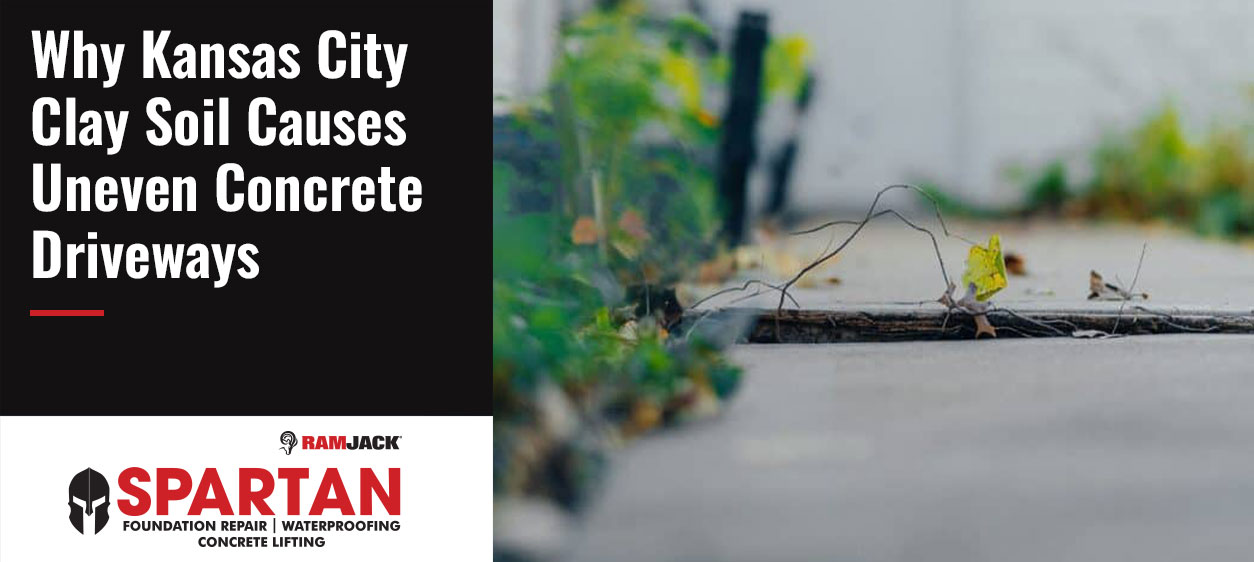
Kansas City clay soil uneven driveway problems stem from a geological reality most homeowners never see. The Kansas City metropolitan area sits almost on the Wymore-Ladoga soil complex, which carries a very high shrink-swell rating. That is, the clay-rich soil absorbs large amounts of water and swells, then contracts as it dries. Your home’s driveway in Kansas City endures 40 to 50 full shrink-swell cycles throughout its life. Each one compounds the damage left by the last. Furthermore, a typical Kansas City winter delivers 50 to 70 freeze-thaw transitions. Cracks form and only grow wider and deeper. This piece explains why your driveway sinks, how expansive clay soil Kansas City creates voids beneath concrete slabs, and what Spartan Ram Jack can do to level it permanently.
Understanding Kansas City’s Expansive Clay Soil
What makes clay soil expansive
Montmorillonite drives the destructive behavior of Kansas City soil composition. This clay mineral belongs to the smectite family and has a unique molecular structure that absorbs water between its layers. Water molecules insert themselves into the gaps and push the flat, submicroscopic clay plates apart. The entire soil mass swells as a result. Pure montmorillonite can expand up to 15 times its original volume, though natural soils with mixed composition swell less. Kansas City’s Wymore-Ladoga clay contains montmorillonite in concentrations high enough to produce volume changes of 10 to 15 percent when transitioning from dry to saturated conditions.
The expansion generates massive force. Saturated montmorillonite clay exerts pressures exceeding 10,000 pounds per square foot against any confining structure, including your concrete driveway slabs. The opposite process occurs when the clay dries out. Water molecules exit the spaces between clay plates. The plates collapse together and the soil mass shrinks. This contraction creates voids beneath concrete and removes the support your driveway needs to stay level.
Why Kansas City has clay content
The Kansas City metro formed over loess deposits and glacial till. Loess consists of wind-deposited silt that accumulated during glacial periods and eventually weathered into clay-rich soil. The Ladoga soil series formed in loess on convex summits, side slopes and stream terraces. The Wymore series developed from similar parent materials across the dissected till plains that define the region’s topography.
The result is 60 to 80 percent clay content across most residential areas in the metro. Johnson County holds the deepest, most expansive pure clay in the region. Jackson, Clay, Platte and Wyandotte counties all sit on the same problematic Wymore-Ladoga association.
How KC clay is different from well-draining soils
Kansas City’s expansive clay soil falls into Hydrologic Soil Group D, the USDA’s classification for soils with very low infiltration rates. Water pools at the surface rather than draining through. Saturated hydraulic conductivity for the Ladoga series measures just 0.1 to 10.0 micrometers per second. Rainfall sits on top of Kansas City clay and saturates it slowly from above rather than percolating down and away.
Sandy or loamy soils drain quickly because larger particles create bigger pore spaces. Clay particles are plate-like and microscopic. They pack tightly together and block water movement. Surface runoff potential ranges from negligible to high depending on slope, but the clay itself resists absorbing water quickly.
The Wymore-Ladoga soil complex in Kansas City
The Wymore-Ladoga complex dominates the eight-county Kansas City metro footprint. The USDA Natural Resources Conservation Service classifies both series as fine, smectitic soils with very high shrink-swell ratings. The classification spans both sides of the state line enough that county boundaries matter less than soil type for predicting driveway damage.
How Clay Soil Movement Damages Your Driveway
Spring and summer: soil swelling pushes slabs upward
Kansas City clay absorbs rainfall and expands beneath your driveway during wet months. The swelling generates upward pressure that can exceed 20,000 pounds per square foot and lifts concrete slabs unevenly. Heaving occurs when saturated clay pushes one section of your driveway higher than adjacent sections. Your driveway’s middle may remain stable while edges rise and create stress fractures across the slab.
Fall and winter: soil shrinking creates voids underneath
Dry weather causes clay to contract and pull away from your concrete’s underside, unlike the swelling process. This shrinkage creates empty spaces beneath your driveway. Gravity pulls the unsupported slab downward into the void when soil support disappears. Settlement cracks form where concrete drops into these gaps.
Why repeated shrink-swell cycles crack concrete over time
Concrete cannot flex. Each shrink-swell cycle subjects your driveway to opposing forces that accumulate damage. The slab bends during each heave event and then drops during each shrinkage period. Microcracks form and widen with every cycle. Structural cracks split the concrete after years of repeated stress.
Why driveway edges and corners fail first
Your driveway’s perimeters experience the most dramatic soil moisture swings. Edges dry faster than the center and cause differential movement where one side shrinks while another stays saturated. Corners lack support on two sides, which makes them especially vulnerable to cracking and displacement.
Poor drainage and downspouts worsen the problem
Downspouts placed near your driveway saturate the soil beneath concrete joints. Water seeps through cracks and erodes the subgrade to create voids that cause sections to sink. Downspouts should discharge at least 10 feet from driveways to prevent erosion. Poor grading that slopes toward your driveway traps water at slab edges and keeps clay wet longer, which intensifies swelling pressure.
Signs Your Driveway Is Affected by Clay Soil
Visible dips, humps, or wave-like surfaces
Your driveway should sit flat. Soil shrinks and creates voids where depressions take shape, and concrete sinks into these empty spaces. Swelling clay pushes sections upward unevenly and causes humps to appear. Differential settlement produces wave-like surfaces as adjacent slabs move at different rates. Ripples spreading from a single location or slight dips that resemble minor potholes show you have unstable soil beneath your concrete.
Cracks running through concrete slabs
Hairline cracks stem from surface curing and measure less than 1/8 inch wide. Soil movement underneath causes wide or growing cracks. Spider web patterns (crazing) affect only the surface. Structural cracks run through entire slabs and widen over time because repeated shrink-swell cycles stress concrete beyond its flex capacity. Drainage problems often show up as cracks near expansion joints or your garage.
Gaps between driveway sections
Uneven settlement creates spaces between slabs. One section may sit higher than the adjacent piece and create a visible lip where they meet. Gaps that widen over time signal ongoing soil movement. Water infiltrates through these voids, erodes base material and accelerates damage.
Standing water in low spots
Settlement creates depressions where water pools. Water that remains hours after rain indicates low spots from soil shrinkage. Clay absorbs water slowly, so puddles persist longer on Kansas City driveways. Pavement edges weaken from standing water, which contributes to crack expansion.
Does driveway damage mean foundation problems too
Driveway cracks can signal foundation issues because both structures rest on the same clay. Settlement or subsidence creates visible cracking in driveways first. Growing cracks near your home warrant foundation inspection, especially those that continue to expand. The same soil conditions affecting your driveway stress your foundation walls at the same time.
How to Fix and Prevent Clay Soil Driveway Damage
Polyurethane concrete lifting to level sunken slabs
Polyurethane foam injection raises sunken concrete by drilling 5/8-inch holes and pumping expanding foam beneath the slab. The foam cures to 95% strength within 15 to 20 minutes and supports loads up to 14,000 pounds per square foot. Polyurethane weighs just 2.5 to 4 pounds per cubic foot compared to mudjacking’s 100 pounds per cubic foot. This reduces pressure on failed subgrade.
Drainage correction to reduce soil moisture swings
Drainage correction stabilizes soil moisture beneath your driveway. French drains or trench drains redirect water away from concrete edges. Proper slope should drop 1/8 to 1/4 inch per foot and move water toward approved discharge points.
Managing downspouts and grading around your driveway
Downspouts must extend at least 6 feet from your driveway, though 10 feet provides better protection. Grading should slope 6 inches over 10 feet away from concrete. Downspouts that discharge onto driveways cause joint erosion and void formation beneath slabs.
Root barrier installation near trees
Root barriers redirect tree roots downward and prevent moisture extraction from soil beneath driveways. Barriers should be 24 to 36 inches deep for most trees using high-density polyethylene panels. Barriers must extend above soil level to prevent roots from growing over the top.
When full replacement is needed instead of lifting
Replacement becomes needed when concrete shows severe cracking across more than 25 to 30 percent of the surface. Badly broken or crumbling slabs cannot be lifted. Base failure requires replacement with proper grading and compacted subgrade.
Conclusion
Kansas City clay soil will continue cycling through expansion and contraction, but your driveway doesn’t have to fail. The problem stems from geological conditions you cannot change, yet Kansas City polyjacking concrete lifting offers a permanent fix at a fraction of replacement cost.
Spartan Ram Jack’s foam injection stabilizes sunken slabs in hours rather than days. Address your uneven driveway repair Kansas City needs now and you’ll prevent the damage from spreading to costlier structural problems.