
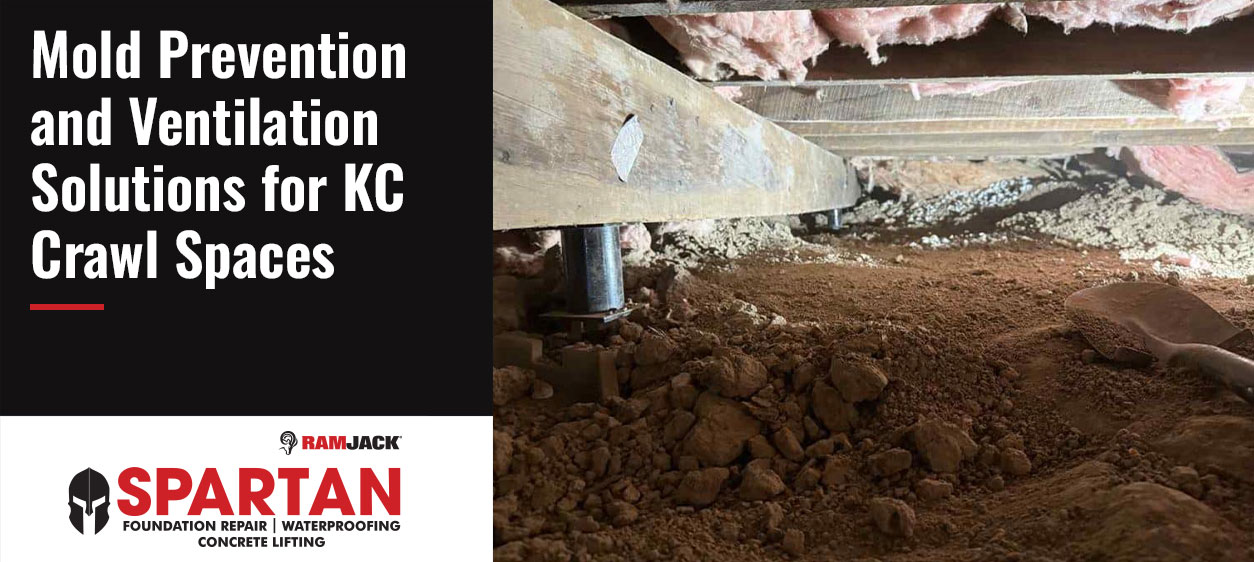
A musty smell from your vents usually signals that something’s wrong beneath your home. Most mold problems in crawl spaces trace back to moisture problems that go unnoticed until homeowners experience cold floors, drafts, or increased allergy symptoms. A damp, uninsulated crawl space can lead to mold growth, pest infestations, and higher energy bills. Crawl space mold prevention becomes critical for Kansas City homeowners. Spartan Ram Jack Kansas City understands the unique challenges our region faces. This piece will walk you through why Kansas City crawl spaces are vulnerable to mold, proven prevention methods including crawl space encapsulation in Kansas City, and ventilation solutions that stop mold growth. We’ll also cover how Kansas City crawl space waterproofing can protect your home long-term.
Why Kansas City Crawl Spaces Are Prone to Mold
Kansas City sits in IECC Climate Zone 4A, a mixed-humid region where crawl spaces face year-round moisture challenges. Hot, humid summers combine with frequent thunderstorms and winters marked by freeze-thaw cycles that stress foundation soil. The region receives an average of 42 inches of annual rainfall, with intense spring and summer storms exposing homes to excess groundwater.
Clay-heavy soil makes matters worse. Sandy soil drains fast, but the dense clay common in Kansas City absorbs water and expands. This presses moisture against foundation walls and crawl space floors. Saturated clay pushes water vapor inside during wet periods. The soil shrinks as it dries and creates voids that reduce structural support.
Summer humidity drives the most persistent problems. Relative humidity ranges from 75 to 85 percent during morning hours from June through September, with sustained dew points above 65°F for weeks. This warm, moisture-laden outdoor air enters through foundation vents or perimeter gaps and contacts crawl space surfaces that remain at ground-coupled temperatures of 60 to 68°F. The incoming air cools fast. Relative humidity rises toward saturation, and condensation forms on foundation walls, ductwork, and floor joists.
Winter freeze-thaw cycles create microcracks in foundation walls. Moisture infiltrates during spring thaw through these cracks.
Effective Mold Prevention Methods for Your Crawl Space
You need to address moisture at every entry point to stop mold before it starts. Crawl space encapsulation creates a sealed environment that blocks humidity, groundwater vapor, and outside air from entering the space beneath your home. The process involves installing a heavy-duty vapor barrier on floors and walls, sealing foundation vents and air leaks, adding insulation to rim joists, and controlling humidity with dedicated dehumidifiers.
Water intrusion problems must be fixed first. Exterior grading corrections and plumbing leak repairs remove active water before encapsulation begins, along with perimeter drains or sump pumps where needed. These sources will continue introducing moisture faster than any system can remove it without being addressed.
Vapor barriers are the foundations of Kansas City crawl space waterproofing. A continuous polyethylene barrier, 10 to 20 mil thick, covers the ground and extends up foundation walls. Seams should overlap and be taped. Edges must be sealed to walls and piers to eliminate air pathways. Barriers installed correctly block evaporative ground moisture that propels mold development.
Dehumidifiers maintain the controlled environment. Crawl space units keep relative humidity below 50 to 55 percent, which prevents mold spores from activating. These systems work best after encapsulation seals the space since they control residual humidity rather than fighting continuous outdoor air infiltration.
Ventilation Solutions That Stop Mold Growth
Traditional vented crawl spaces operate on flawed logic. The theory assumes outdoor air removes moisture, but this works only at the time outdoor air is drier than crawl space air. That condition rarely exists during summer months in Kansas City’s climate at the time moisture problems peak.
Here’s what happens during a typical July. Outside air at 90°F and 75% humidity enters through foundation vents and contacts cooler crawl space surfaces at 65 to 75°F. Condensation forms. The vents designed to dry your space actually make it wetter. Field measurements show vented crawl spaces running at 70 to 85% relative humidity during summer. Sealed spaces with mechanical drying stay at 45 to 55%.
The stack effect pulls crawl space air into your home. About 40% of the air on your first floor originates from the crawl space. Your indoor air quality suffers at the time that air carries mold spores and excess moisture.
Controlled ventilation paired with encapsulation solves this problem. Fresh outside air enters only at the time conditions are favorable—cooler and drier than interior air. Sensors monitor both environments and determine optimal ventilation timing. Foundation vent fans equipped with humidistat controllers activate at the time humidity rises. They improve air circulation without introducing additional moisture. The EPA recommends maintaining crawl space humidity between 40 and 50% to prevent mold formation.
Free Crawl Space Waterproofing Evaluation
Regular inspections save money by catching problems before they escalate into expensive repairs. Without seasonal checks, utility bills climb due to faulty systems, floors feel damp, and mold spreads unnoticed. Then scheduling a professional evaluation becomes essential to protect both your investment and your family’s health.
Professional inspectors use specialized equipment that goes beyond visual assessment. Hygrometers measure humidity levels throughout the space, while infrared cameras detect hidden leaks and temperature variations that signal moisture intrusion. Moisture meters identify dampness in wood and building materials before visible damage appears. This detailed approach means no problem area gets overlooked.
Technicians check foundation walls, joists, beams, insulation and ventilation systems during an evaluation. They look for signs of water damage including dampness, standing water or rusted pipes. Musty odors, sagging floors or condensation on pipes indicate it’s time to schedule an inspection.
Not every inspection ends with major repairs. Sometimes the recommendation involves monitoring conditions or improving moisture control. Other times, solutions like Kansas City crawl space waterproofing, drainage systems or structural reinforcement may be suggested. The important thing is that recommendations connect to issues found directly, not generic solutions.
At Spartan Ram Jack Kansas City, we provide free crawl space evaluations with no obligation and help you understand what’s happening beneath your home.