
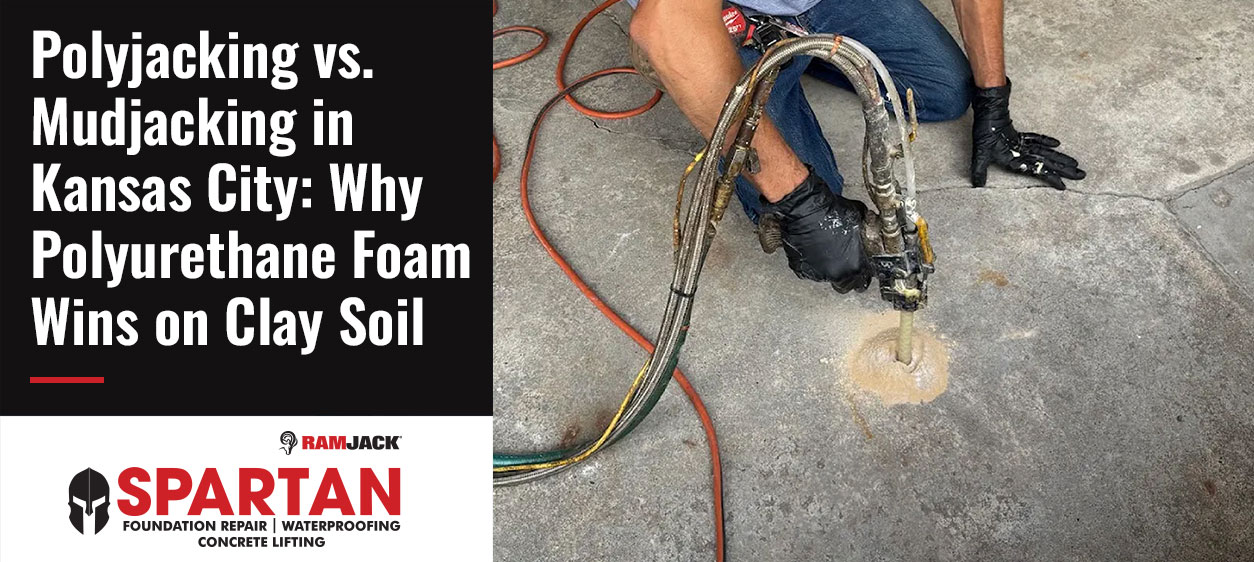
At the time you compare polyjacking vs mudjacking in Kansas City, the soil beneath your concrete matters as much as the repair method itself. Kansas City sits on expansive Wymore-Ladoga clay that swells when wet and shrinks when dry. This creates voids that cause slabs to settle. Polyurethane foam concrete lifting in Kansas City has taken over most modern residential applications in the local clay soil. The foam is lightweight and won’t add load to the soil beneath the slab. Traditional mudjacking uses heavy cement slurry that can stress ground that is unstable. The foam cures in 15 to 30 minutes and allows same-day use. This piece explains which is better polyjacking or mudjacking to level concrete on clay soil. You’ll learn when each method makes sense and why material weight and cure time matter on expansive clay.
Quick Answer: Polyjacking vs. Mudjacking on Clay Soil
Polyjacking outperforms mudjacking on Kansas City clay soil because it adds minimal weight to unstable ground and resists the moisture cycles that undermine heavier cement slurry. Kansas City’s Wymore-Ladoga clay soils create shrink-swell conditions that affect both methods. Mudjacking slurry sitting on expansive clay can be displaced by soil movement during wet seasons. Dry seasons bring another problem: the clay shrinks and leaves the slurry unsupported. Polyjacking foam adheres to both the slab’s bottom and the soil surface. This adhesion maintains contact through moderate shrink-swell cycles. The lighter foam weight also means less downward pressure on clay that cycles through volume changes.
Polyurethane foam weighs just 2 to 4 pounds per cubic foot. Mudjacking slurry weighs around 100 pounds per cubic foot. Adding that cement grout density load to fill soil creates conditions for renewed settlement. The soil already showed it cannot support slab weight at its original density. Polyjacking is hydrophobic and resists water penetration. Mudjacking slurry absorbs groundwater and can deteriorate faster in wet conditions.
Mudjacking still makes sense for budget-sensitive projects and large voids where material volume drives cost. For most residential applications on Kansas City’s reactive clay, polyurethane foam delivers better long-term performance.
Why Kansas City Clay Soil Changes the Equation
Expansive clay swells when wet and shrinks when dry
Kansas City clay soil absorbs water and expands during wet seasons, then contracts when dry conditions return. This expansion can create swelling pressures exceeding 20,000 to 30,000 pounds per square foot. The movement happens unevenly across a slab because moisture distribution varies. Perimeter areas exposed to rainfall and irrigation cycle more than protected interior zones. One section may heave while another settles, and differential movement fractures concrete. This creates the uneven surfaces you see in driveways and sidewalks. The cycle repeats without end and accumulates stress on structures season after season.
Why added weight on unstable clay accelerates settlement
Mudjacking slurry adds weight to soil that already failed to support the original slab and creates conditions for renewed settlement. Cement slurry weighs around 100 pounds per cubic foot, heavier by a lot than the 2 to 4 pounds per cubic foot of polyurethane foam. Clay shrinks and pulls away from the slab underside, and gaps form. Heavy fill material sits in those voids during the next expansion cycle and experiences greater displacement than lightweight alternatives.
How freeze-thaw cycles test fill material durability
Freeze-thaw damage occurs when water fills voids in porous material, then freezes and expands by 9 percent. Repeated freezing enlarges cracks. More water penetrates during the next thaw. Kansas City’s freeze-thaw cycles stress both the clay soil beneath and the fill material injected to lift the slab at the same time.
How Mudjacking Works
What mudjacking is: cement slurry pumped through drilled holes
Mudjacking pumps a cement-based slurry beneath settled concrete to fill voids and lift the slab back to grade. Contractors drill holes through the sunken slab in a grid pattern. These holes measure 1.5 to 2 inches in diameter. A hydraulic pump forces the slurry mixture through these holes and into the void space beneath. The slurry composition has Portland cement, sand, and water. Sometimes additives like limestone dust, fly ash, or small amounts of clay improve workability. The slab begins to rise as the material fills empty spaces and builds pressure. Operators monitor elevation with levels and adjust pump pressure until the slab reaches the correct height. The drilled holes are patched with quick-setting cement once lifted.
Where mudjacking still makes sense
Mudjacking remains budget-friendly for projects with tight budgets and large voids where material volume drives total cost. The process costs roughly half as much as complete concrete replacement.
Limitations: heavy material and longer cure time
Cured mudjacking slurry weighs 100 to 140 pounds per cubic foot. This weight can contribute to future settlement on weak or compressible soils. Mudjacking can take 24 to 72 hours to cure before foot traffic is allowed.
How Polyjacking Works
What polyjacking is: polyurethane foam injected through small holes
Polyjacking injects a two-component polyurethane mixture beneath the slab through holes drilled about 5/8 inches in diameter. The two liquid components mix at the injection gun tip and begin expanding right away. The foam expansion ratio reaches 15:1 to 20:1 depending on the product formulation. This generates enough force to lift concrete and fill every cavity it contacts. Technicians monitor the slab surface with a level while injecting. They control the lift with precision. The foam reaches 90 percent of its final strength in just 15 minutes.
Why lightweight foam reduces stress on clay soil
The soil beneath your settled slab already showed it cannot support the original load. Polyjacking fills voids without increasing the load on weakened subgrade. The foam also compacts loose soil during expansion. This densifies the base to better support the restored slab.
Why water resistance matters in Kansas City
Polyurethane foam forms a closed-cell structure that blocks water infiltration. This hydrophobic barrier prevents soil washout beneath the slab and maintains structural integrity even when groundwater saturates the subgrade. In contrast to mudjacking slurry, the foam resists Kansas City’s moisture cycles that cause clay expansion and contraction.
Polyjacking vs. Mudjacking: Side-by-Side Comparison
Both methods lift settled concrete, yet their material properties produce different outcomes on shrink-swell soil. The comparison below explains performance differences that matter when choosing sunken concrete repair Kansas City options.
| Factor | Polyjacking (Polyurethane Foam) | Mudjacking (Cement Slurry) |
| Material weight | 2–4 lbs per cubic foot | 100+ lbs per cubic foot |
| Access hole size | 5/8 inch diameter | 1–2 inch diameter |
| Cure time | 15 minutes to 90% strength | 24–48 hours |
| Moisture resistance | Hydrophobic, repels water | Absorbs water |
| Performance on clay soil | Lightweight fill reduces load on reactive soil; expands to fill voids left by shrinking clay | Added weight can accelerate settlement on weak subgrade; material can wash out with groundwater movement |
Polyurethane foam concrete lifting Kansas City delivers superior performance on expansive clay, then.
Why Polyurethane Foam Performs Better on Kansas City Clay
Four material properties explain why polyurethane foam concrete lifting Kansas City delivers superior long-term results on expansive clay compared to traditional mudjacking.
Lightweight fill reduces load on reactive soil
Polyurethane foam weighs just 2 to 8 pounds per cubic foot while supporting loads up to 14,000 pounds per square foot. You’re adding minimal weight to soil that already settled under the original slab, so the repair does not introduce additional stress that could trigger renewed settlement. Mudjacked slabs often re-settle within 2 to 5 years. The added mass further compresses compromised soil beneath.
Water-resistant material withstands wet-dry cycles
The closed-cell structure blocks water infiltration and makes the cured foam hydrophobic. This prevents the moisture absorption that causes cement slurry to deteriorate in saturated Kansas City clay soil conditions. Polyurethane maintains structural properties for 10 to 15 years or more.
Expands to fill voids left by shrinking clay
The foam flows into voids as a liquid before expanding and solidifying. It conforms to irregular geometries left when clay contracts during dry periods. This complete fill prevents hollow pockets that create weak spots beneath the slab.
Faster cure means same-day use
The material cures to 95% strength in 15 to 20 minutes and allows same-day use. Rooms and driveways return to service the same day.
Cost vs. Long-Term Value
Upfront cost comparison: mudjacking vs. polyjacking
Mudjacking costs $3.00 to $8.00 per square foot, with most residential projects ranging from $600.00 to $2,500.00. Polyjacking runs $5.00 to $25.00 per square foot, with projects landing between $1,000.00 and $3,000.00[241]. The polyurethane foam used for polyjacking costs roughly four to five times more than the cement slurry mixture used for mudjacking. As a result, mudjacking comes in about 20 to 40% less expensive upfront.
But repair longevity changes the cost equation. Mudjacking repairs last 2 to 5 years, while foam lifts hold 10 to 15 years or more when installed correctly. A $900.00 mudjacking job repeated every five years costs more over fifteen years than one $1,800.00 polyjacking job.
Factors affecting concrete lifting cost
Square footage is the least reliable predictor of your final invoice. Void depth below the slab and the amount of lift required determine how much material gets pumped. Access also matters, as slabs surrounded by landscaping or fences add 20 to 50 percent in labor.
When Lifting Isn’t the Right Fix
Concrete lifting has clear limitations that contractors assess before recommending repair.
Severely cracked or structurally failed slabs
Lifting won’t fix concrete that is cracked or deteriorating. Replacement becomes the appropriate choice when slabs show extensive spalling, surface failure, or cracks running in multiple directions. The slab itself must remain sound for lifting to work long-term. Rebar-reinforced slabs that settled without cracking present unique challenges. The rebar bends with the settling concrete and maintains that bent shape. This creates resistance when contractors attempt to lift the slab back to level.
Active drainage problems that need correcting first
Drainage issues accelerate settlement and must be corrected before lifting. Downspouts discharging beside the slab, water pooling after rain, or soil washing away along slab edges are signs to watch for. The problem returns if you fix settled concrete without addressing the drainage that caused it.
How contractors decide between lifting and replacement
Contractors review crack patterns, slab integrity, void depth and soil conditions. Replacement provides better value than attempting to lift compromised material when deterioration is widespread. Access restrictions, utility locations and the need for layout changes also factor into the decision.
Signs Your Concrete Is a Candidate for Lifting
Knowing when your concrete qualifies for lifting saves you from unnecessary replacement costs and identifies repairs before damage spreads.
Sunken or uneven slabs
Settlement creates uneven surfaces between adjacent slabs. Driveways, sidewalks and patios develop height differences at control joints or where one section drops relative to surrounding concrete. Soil beneath compacts or erodes away, causing this problem.
Gaps at slab joints
Separation at expansion joints signals soil movement beneath the surface. These gaps widen as settlement progresses and allow water infiltration that accelerates erosion under the slab.
Hollow sound when tapping the surface
A resonant, hollow sound when you tap or walk on concrete indicates voids beneath the slab. The hollow sound and feel signal unseen erosional voids underneath these exterior concrete surfaces.
Water pooling in low spots
Puddles forming in the same spots after rain indicate the concrete has settled unevenly. Low areas collect runoff. Standing water that lingers long after everything else has dried confirms settlement.
Trip hazards
Uneven surfaces create tripping hazards and increase liability risks. Height differences exceeding 1/4 inch between adjacent slabs pose safety concerns for pedestrians. They can lead to ADA compliance violations.
The Polyjacking Process, Step by Step
Inspection of slab and voids
Technicians check the slab for settlement patterns, structural soundness, and void locations beneath. A level survey maps low spots and estimates void volume. This assessment determines whether polyjacking is appropriate or whether the concrete requires replacement.
Drilling small access holes
A 5/8-inch masonry bit drills through the slab at marked locations. Typical spacing runs 3 to 6 feet, with tighter spacing in areas of deeper settlement. The small diameter minimizes slab damage and leaves ports that patch easily after completion.
Injecting polyurethane foam
The two-part polyurethane mixture injects through specialized heated hoses and a mixing gun. The foam expands as the chemical reaction progresses and fills voids while generating lifting pressure. Technicians inject in controlled pulses and check slab movement between each pulse to prevent over-lifting.
Monitoring as slab rises to level
Technicians track the slab’s surface during each injection pulse with a level, laser, or string line. The goal is to lift the slab to match adjacent surfaces or reach a pre-determined target elevation.
Sealing holes and cleanup
Technicians seal each port with a concrete patch compound or polyurethane plug. The foam reaches 90 percent cure within 15 minutes and makes the slab walkable immediately.
Protecting the Repair: Drainage on Clay Soil
Why drainage matters after lifting
Water is the primary reason lifted concrete sinks again. Your slab will settle again when water runs toward it or pools beside it. The moisture washes out soil beneath the repair or weakens surrounding soils and causes settlement to recur. Good drainage protects the base under and around your slab. It extends the life of your concrete lifting Kansas City repair by a lot. Continuous subterranean water flow can erode material over time, especially when you have cement-based repairs.
Downspout extensions and proper grading
Extend downspouts at least 10 feet from your foundation. Kansas City has clay soil conditions that are common in the area. Push that distance to 8 to 10 feet or more. Grade the land around the slab to slope away from structures and drop at least 6 inches over the first 10 feet. This slope will give rainwater a path to flow away before it soaks into expansive clay. Even well-extended downspouts fail to protect your foundation if you don’t have proper grading.
Applies to both foam and slurry repairs
Drainage protection matters whatever lifting method you chose—polyjacking Kansas City or mudjacking Kansas City. You lift concrete but don’t redirect downspouts or address slope issues. Rainwater will erode subgrade soils beneath both polyurethane foam and cement slurry repairs.
How Spartan Ram Jack Lifts Concrete in Kansas City
Free inspection and void assessment
Spartan Ram Jack offers complimentary site inspections for concrete lifting Kansas City projects. Technicians measure settlement depth and map slab position relative to adjacent surfaces. They probe beneath the concrete to estimate void size and location. This gives you a full picture of whether your driveway and sidewalk leveling Kansas City project requires minimal fill or extensive void repair. The inspection also reviews crack patterns and structural integrity. This determines if lifting remains viable or if replacement makes more sense for your situation.
Method recommendation based on conditions
Spartan Ram Jack recommends polyjacking Kansas City based on soil conditions and project scope. For Kansas City clay soil applications where shrink-swell cycles threaten repair longevity, polyurethane foam concrete lifting Kansas City delivers better long-term results. The recommendation accounts for site-specific drainage patterns, especially when downspouts discharge near the slab or grade slopes toward the concrete. Therefore, each proposal outlines the suggested method and explains why that approach fits your conditions. It provides transparent pricing based on actual void volume and lift requirements rather than generic per-square-foot estimates.
Frequently Asked Questions
Is polyjacking better than mudjacking?
Yes. Polacking performs better on Kansas City clay soil because the lightweight foam adds minimal stress to unstable ground and resists moisture infiltration. The closed-cell polyurethane won’t wash out or deteriorate in wet conditions that compromise cement slurry.
How long does polyjacking last compared to mudjacking?
Polyjacking lasts 10 to 15 years or longer. Properly installed foam repairs can reach 30 to 50+ years when maintained. Mudjacking repairs hold 2 to 5 years before requiring re-lifting.
How much does polyjacking cost in Kansas City?
Polyjacking averages $15.00 per square foot. Most projects range from $5.00 to $25.00 per square foot. A 300-square-foot section costs $3,000.00.
How soon can I use my driveway after polyjacking?
You can drive on polyjacked concrete within 15 to 30 minutes. The foam cures to usable strength right after the crew finishes.
Will my concrete sink again after lifting?
Concrete can settle again if soil continues moving or drainage problems persist. Proper grading and downspout management reduce this risk substantially.
Conclusion
The mudjacking vs polyjacking Kansas City decision comes down to soil conditions and repair longevity. Polyurethane foam performs better on Kansas City’s expansive clay because it adds minimal weight, resists moisture cycles and cures in minutes. Spartan Ram Jack reviews your specific conditions and recommends the method that protects your investment long-term. Proper drainage after any lift will give your repair lasting results.