
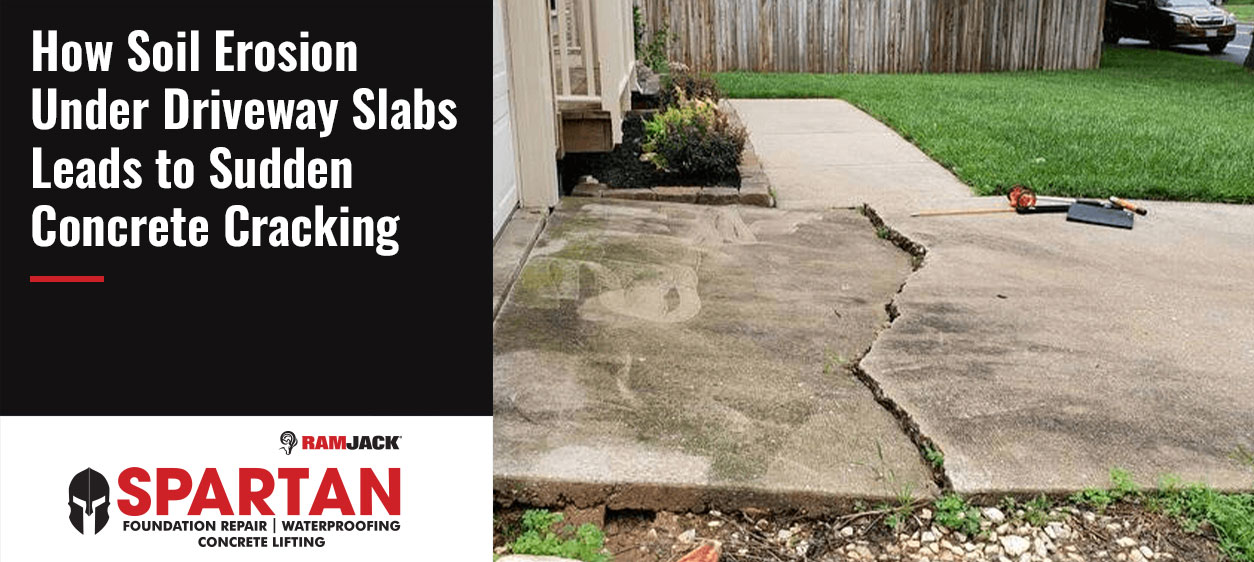
Soil erosion under driveway slab is one of the most common reasons MO and KS homeowners call Spartan Ram Jack for concrete repair. You may walk out one morning to find a sudden concrete crack driveway that wasn’t there the day before. You wonder why your driveway cracked suddenly. That crack isn’t sudden at all though. Water has likely been washing away soil beneath your concrete for months and created a void under concrete slab that left the concrete spanning an unsupported gap. The weight of your vehicle or natural freeze-thaw cycles causes the weakened slab to crack eventually. You address the real problem when you understand these concrete cracking causes: the hidden void and the drainage issue feeding it.
Quick Answer: Why Soil Erosion Causes Sudden-Looking Cracks
The crack looks sudden, but the damage happened over months. Water infiltrates small cracks and joints in your driveway and carries fine soil particles away with each cycle. Moisture freezes and thaws over and over. This forces those openings wider and lets water flow deeper to wash out more supporting soil beneath the concrete.
A void forms under concrete slab that you cannot detect from the surface. Your driveway appears normal because the concrete spans the hollow gap like a bridge. Traffic loads and seasonal weather stress this unsupported section over time, but the slab holds until the concrete’s tensile strength gives out.
Concrete handles compression well but fails under tension. The slab bending over the empty space exceeds what the material can withstand once the void grows large enough. The result: a crack that seems to materialize overnight.
Homeowners throughout Kansas City, Wichita, Springfield, and Columbia experience this pattern. Heavy rainfall and dramatic temperature swings create ideal conditions for soil erosion under driveway slab. Any slab drop greater than 1/2 inch signals active erosion that won’t self-correct. The visible crack is just the final symptom of a problem that started long before you noticed it.
What Is Soil Erosion Under a Slab?
Erosion beneath your driveway occurs when moving water carries soil particles away from under the concrete and leaves empty spaces that compromise structural integrity. Heavy rainfall, poor drainage, leaking pipes and downspouts dumping water near the slab all contribute to this soil washout under slab. Water penetrating through surface cracks slowly erodes the base material below. Fast-moving water loosens soil particles. They displace and transport downhill. The ground that supports your foundation weakens.
The gradual washout of supporting soil beneath concrete
Water flows through voids in the soil created by expansion and contraction cycles. Soil expands and becomes larger at the time it rains, then contracts when weather turns dry. Gaps in the soil form from this expansion and contraction. The next rainfall runs through these voids and washes the material away. Each cycle removes more supporting soil. Larger hollow areas form that concrete cannot detect from above.
Why concrete slabs rely entirely on soil support
Concrete slabs depend on continuous ground contact to distribute weight evenly. The material loses its capacity to support the heavy weight of the concrete as soil erodes. The slab must span the gap like an unsupported beam without this foundation contact. The material stresses beyond its design limits.
How erosion is different from soil compaction or clay expansion
Soil compaction packs material tighter without removing it. Clay expansion pushes upward as moisture increases volume. Erosion physically removes soil particles through water movement. Actual voids form beneath the slab rather than shifting or swelling the existing material.
What Causes Soil to Erode Beneath a Driveway?
Water finds multiple pathways to wash away the ground beneath your driveway and creates voids that lead to concrete cracking causes you notice later.
Downspouts draining under the slab edge
Roof drainage concentrates massive water volumes at single points. Downspouts that discharge onto or beside your driveway create concentrated flow that erodes soil along slab edges faster than dispersed rainfall. This pattern creates localized voids under concrete slab that undermine support where your driveway meets the foundation.
Poor grading directing runoff toward the driveway
A well-engineered driveway requires at least a 2% slope to guide water away from the surface and foundation. Without that slope, water pools and saturates the subgrade. Clay-heavy soils common throughout Kansas City and Wichita experience up to 50% faster base deterioration with poorly graded driveways.
Heavy rainfall washing out fine soil particles
Water carries fine soil particles away from beneath slabs during heavy storms and creates empty spaces. Repeated wetting removes material that supports your concrete over time.
Broken underground pipes near the slab
Leaking sewer lines introduce constant water flow into soil beneath your slab. That water migrates through the soil column and carries particles with it. This creates the soil piping process that removes foundation support.
Natural groundwater movement in sloped yards
Gravity accelerates water movement on sloped terrain and allows it to dislodge supporting soil much faster than on flat ground.
How a Void Forms Beneath the Slab
Water carries soil particles away leaving hollow gaps
Moving water beneath a concrete slab carries fine soil particles with it as it flows. Each rain event or irrigation cycle moves water beneath a slab and can carry a small amount of supporting soil away. Those small losses accumulate into major voids over time, especially when water flows through the same pathways beneath the concrete. Slab edges, joints between panels, and areas near downspout discharge points are most susceptible to void formation.
The slab bridges the void with no surface changes
A gap forms between the slab and the supporting ground when soil erodes and washes away beneath your driveway. The concrete above acts like a bridge and spans the void with no visible surface distress. Your driveway appears normal because the slab holds steady over the unsupported gap.
Traffic and weather weaken the unsupported span over time
Concrete is strong in compression but weak in flexure. The slab flexes under load across the span each time a vehicle drives over the unsupported section. This repeated flexing creates microcracking that accumulates into visible cracking over time.
Why the crack appears sudden when the void took months to form
Voids can develop over years as freeze-thaw cycling rearranges soil particles. The slab holds steady until the span exceeds what the concrete can handle, then cracks suddenly when a vehicle drives over it.
Signs You May Have a Void Forming Under Your Driveway
Your driveway broadcasts warning signals before major cracks appear. You can prevent expensive concrete repairs when you spot these signs early.
Hollow or drumming sound when driving over sections
A hollow sound when you drive over certain areas shows the slab has lost ground contact. Excess vibrations occur when weight hits the floor compared to areas near foundation walls. This drumming noise reveals a void under concrete slab that has separated the concrete from its supporting base.
Slight rocking or flexing under weight
Concrete should feel solid underfoot. Sections that flex or rock when vehicles pass over them span an unsupported gap beneath the surface.
Cracks near drainage points or downspouts
Driveway edge cracking near downspout discharge points signals active erosion. Water concentrates at these locations and speeds up soil washout under slab. This creates the conditions for structural failure.
Visible settling or dipping before full cracking
Low spots that hold puddles show the base beneath has already moved. Uneven or sloped surfaces signal that sections have started to sink and create noticeable dips where moisture collects instead of draining away.
Water pooling in specific spots after rain
Standing water after storms reveals more than poor drainage. Pooling erodes soil underneath your slab and creates voids that cause the concrete to move and crack over time. Water that stays in the same spot for a day after rain means that location settles deeper with each cycle.
Why Sudden Cracks Are Rarely Actually Sudden
Driveways rarely fail overnight. Most damage develops over time due to weather exposure, aging materials and structural stress. Your concrete expands, contracts, cures and settles over time, with climate accelerating that process. Warm afternoons followed by freezing nights create constant expansion and contraction that stresses the material until hairline fractures appear.
A properly installed driveway can develop cracks under these conditions. The crack doesn’t mean poor construction. Concrete responds to weather cycles you cannot control.
Concrete doesn’t usually fail first. The support under the concrete fails first, until you notice cracking or settlement. A void can exist for months before you see obvious sinking, more so if the slab is thick, reinforced or supported at the edges. This damage makes it easy to dismiss early warning signs because of its gradual nature.
Why this difference matters when choosing the right repair
What changed helps you decide whether to monitor the damage, arrange concrete repairs or call a qualified professional. A crack alone doesn’t confirm a void. Pair the crack with other clues: hollow sounds nearby, rocking, a change in level, edge gaps or worsening after rain.
Most driveway cracks are manageable when you address them early. Small repairs prevent water from entering and slow deterioration. You address the cause rather than just the symptom and that will give your repair investment a longer life.
What Happens If You Only Patch the Crack Without Fixing the Void
Patching a crack without addressing the void under the concrete slab beneath it wastes time and money. The surface repair treats a symptom while ignoring concrete cracking causes that created the damage.
Surface patching doesn’t restore slab support
You fill cracks with sealant or patching compound, but this does nothing to restore ground contact beneath the slab. Concrete is strong in compression but not designed to span gaps like a bridge. The slab flexes, cracks, or settles whatever you apply to the surface when support disappears. Homeowners throughout Kansas City, Wichita, Springfield, and Columbia find this reality when patched cracks reappear within months.
The void continues growing and causes repeat cracking
A void acts as a multiplier problem. You ignore it longer, and your repair expands into demolition and replacement. Voids lead to worsening cracks and structural stress on adjacent slabs. Concrete repair costs climb higher later.
Why addressing drainage prevents recurrence
Better drainage prevents further washout and reduces moisture-driven movement. If a void exists, the slab remains unsupported in part. Pair water control with restoring contact beneath the slab for lasting results. Water continues eroding soil and creating new voids if you don’t correct driveway drainage problems.
How to Repair a Driveway Slab Affected by Soil Erosion
Polyurethane foam injection to fill voids
Polyurethane foam injection restores support beneath your driveway without removing existing concrete. Small holes, about the size of a pea, are drilled into the slab. A two-part foam injects beneath the concrete and expands within seconds to fill voids, stabilize loose soil, and lift the slab back to level. The foam cures to 90% strength in 15 minutes and supports up to 7,200 pounds per square foot. Most projects complete in a few hours. You can drive on the surface the same day.
How this is different from pouring new concrete
Concrete replacement requires demolition and re-pouring, plus curing that takes 7 days minimum or 3 days with special mixes. That means no parking or walking on your driveway for days. Polyurethane foam injection costs 50-75% less than full replacement, skips heavy machinery and produces minimal mess.
When full slab replacement is necessary work
Replacement becomes necessary work when concrete has broken into sections smaller than 3 feet by 3 feet or shows widespread cracks running multiple directions. The same applies if the slab has settled 6-8 inches or more. If the slab is crumbling or flaking extensively, foam injection cannot restore structural integrity.
The Repair Process Step by Step
Inspection to locate the void and erosion source
A technician inspects your concrete and determines settlement extent, identifies problem areas, and maps injection points. The assessment establishes the lift plan that guides the whole job. It evaluates slab thickness, settlement degree, soil condition, and factors affecting the injection process. Slabs throughout Kansas City, Wichita, Springfield, and Columbia get this evaluation that reviews drainage flow and downspout locations. The technician checks whether water continues washing soil away.
Drilling small access holes into the slab
Small holes are drilled at key locations, typically 5/8 inch in diameter and roughly the size of a dime. Injection ports install into these holes and serve as access points to deliver foam.
Injecting polyurethane foam to fill and stabilize
Dual-component polyurethane foam injects through ports using specialized high-pressure equipment. The foam expands to about 15 times its original volume and flows into voids. It compacts loose soil.
Lifting the slab back to level
The technician monitors slab rise using levels or laser sensors and achieves precision within 1/8 inch of target elevation.
Sealing access holes
Injection holes are patched with concrete grout or matching sealant that hardens once lifting completes. The patches become nearly imperceptible. The foam cures to 95% of final strength within 15 to 20 minutes.
Correcting the drainage issue
Drainage problems need attention to prevent water from continuing to erode soil and create new voids. You get lasting results when you fix the root cause.
Preventing Future Erosion and Cracking
Keeping soil erosion under driveway slab from recurring requires you to address water sources that caused the original damage. These prevention steps protect your investment throughout Kansas City, Wichita, Springfield, and Columbia.
Redirect downspouts away from the driveway
Downspouts concentrate roof runoff at single discharge points. Extensions must carry water five feet from your foundation to prevent driveway drainage problems. Extend discharge points to ten feet for homes with basements. Splash blocks at extension ends prevent lawn erosion and direct flow toward safe drainage areas.
Correct yard grading to move water away
Positive grading slopes soil away from your foundation so surface water drains naturally rather than pooling. A minimum 2% slope prevents water from lingering against foundation walls. Proper grading reduces base deterioration by up to 50% in clay-heavy soils common to your area. Reshape topography to move runoff toward safe outlets and keep mulch and soil six inches below siding.
Repair underground drain leaks
Leaking irrigation lines or sewer pipes introduce constant moisture beneath slabs. Small stress cracks or pinholes in underground pipes can be sealed without excavation if pressure loss registers at five pounds or less over thirty seconds. Broken pipes require replacement.
Periodic inspection for hollow sounds or settling
Walk your driveway quarterly and listen for drumming sounds that signal new voids forming. Address hollow areas before full cracking develops.
Cost Factors for Homeowners
Repair costs vary based on multiple factors specific to your situation. What drives pricing will help you budget accurately and avoid unexpected expenses.
Size of the void and affected area
Void extent is the biggest cost driver. Larger or deeper voids require more material and labor and raise overall expenses. A small void under 100 square feet with shallow depth costs less than extensive voids exceeding 200 square feet or reaching depths beyond 3 inches.
Whether drainage correction is needed
Drainage solutions become necessary when poor water management caused your concrete problems. French drains or regrading to redirect water away from your driveway can add $2,000 to $7,000 to your project. You prevent the same problems from recurring when you address drainage. This makes the expense worthwhile for homeowners throughout Kansas City, Wichita, Springfield and Columbia.
Repair versus full slab replacement
You save 50% to 70% compared to full replacement when you repair your sinking slab. Polyurethane foam injection costs more upfront than mudjacking but offers superior durability and fewer long-term maintenance costs. Replacement becomes the better long-term investment when repair costs approach 50% of replacement cost.
Accessibility of the affected area
Limited site access requires additional equipment or manual labor and escalates expenses[422]. Hard-to-reach areas increase labor costs, especially when you need special equipment.
How Spartan Ram Jack Diagnoses and Repairs Erosion-Damaged Slabs
Spartan Ram Jack has served homeowners throughout Kansas City, Wichita, Springfield, and Columbia since 2007. The company brings specialized expertise to concrete slab settlement causes and void repair. Part of the national Ram Jack network, it combines proven methods with local knowledge of regional soil conditions and drainage patterns common to Missouri and Kansas.
A trained consultant performs an on-site evaluation to start the diagnostic process. This determines settlement extent and identifies erosion sources. Technicians assess visible signs like cracks, hollow sounds and drainage issues. They then use advanced diagnostic tools to understand what’s happening below the surface. This custom approach recognizes that no two concrete issues look alike.
Spartan Ram Jack uses polyurethane foam injection for driveway slab erosion repair. The foam fills voids and restores support. The company also offers mudjacking services for certain applications and helical pile installation when foundation-level support becomes needed. Their methods are ICC-ES certified and backed by a transferable structure’s life warranty.
All crews are full-time employees rather than subcontractors. The company maintains full licensing, insurance and bonding. This will give consistent quality and accountability throughout the repair process.
FAQs
Why did my driveway crack with no warning?
Your driveway did give warnings, but soil erosion under driveway slab happens beneath the surface where you cannot see it. Water washed away supporting soil for months and created a void under concrete slab. The concrete failed when the unsupported span exceeded what the material could handle.
How do I know if there’s a void under my driveway?
A hollow sound is a red flag that deserves closer examination. As with this, look for slight rocking under vehicle weight, cracks near downspouts, or water pooling in the same spots after rain. Manual sounding helps pinpoint suspicious areas, but professional inspection reveals the true extent of concrete slab settlement causes.
Can you fix a void without replacing the whole driveway?
Most cases allow this. Polyurethane foam injection fills voids and restores support without tearing out existing concrete. This addresses the settlement causing the crack and restores the slab’s level.
Will the crack come back if I only patch it?
Surface-only crack repairs fail when the slab keeps moving as support underneath shifts or settles from drainage issues under driveway. Crack repairs fail until the void or settlement gets addressed if support under a slab changes due to erosion.
Conclusion
Soil erosion under driveway slab creates voids that take months to form but crack seemingly overnight. You need more than surface patching to address concrete cracking causes. Polyurethane foam injection fills voids and restores support at nowhere near the cost of replacement. Proper drainage correction prevents recurrence. Spartan Ram Jack brings proven expertise to homeowners throughout Kansas City, Wichita, Springfield, and Columbia. Early intervention saves money and protects your investment for years to come.