
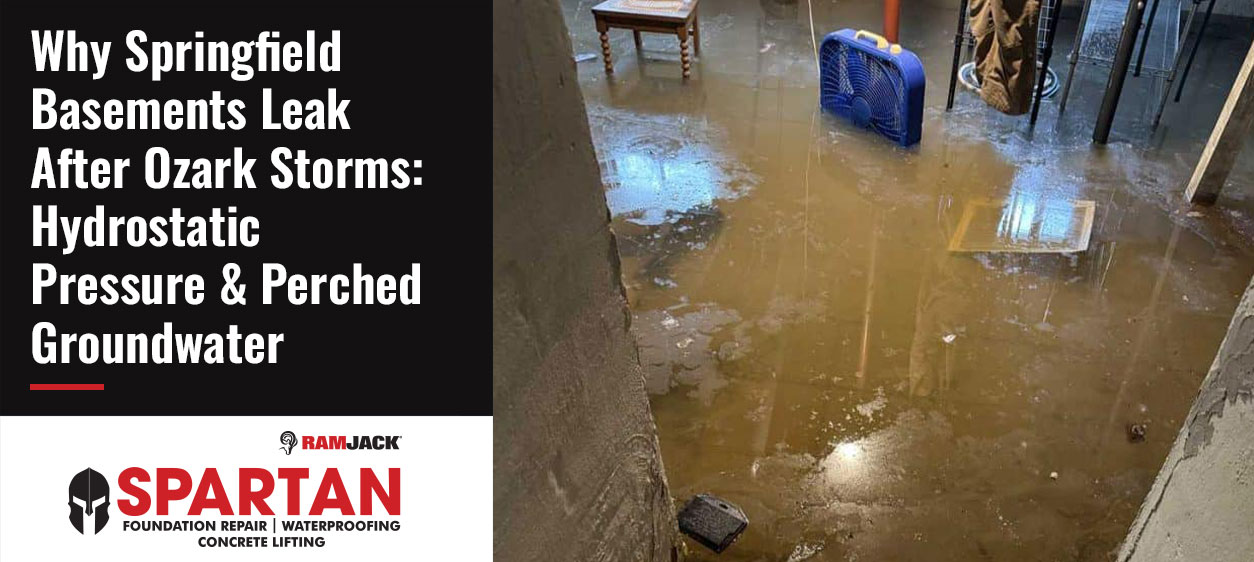
Your neighbor’s basement stays dry. Yours floods within hours of a hard Ozark storm. Springfield basement leaks hydrostatic pressure searches often begin with this exact contrast. The ground beneath Springfield is the reason — fractured karst limestone that drains unevenly, trapping rainwater in isolated pockets of perched groundwater well before it ever reaches the regional water table. That trapped water builds hydrostatic pressure fast, often pushing against concrete basement walls with forces exceeding 100,000 pounds, driving water through hairline cracks and cove joints. Left alone, that moisture can trigger mold growth in as little as 24 to 48 hours.
Springfield’s geology doesn’t behave like ordinary ground — and ordinary fixes don’t hold up against it. This guide breaks down why Ozark storms hit some Springfield basements so much harder than others, and what you can do to protect your foundation before the next storm rolls through.
What Makes Springfield’s Ground Different?
For homeowners researching Springfield basement leaks, hydrostatic pressure begins with the maze of limestone beneath each neighborhood. This ground does not behave uniformly, which explains why storm response varies so much from one foundation to the next.
Springfield Plateau Groundwater & the Burlington Limestone
Springfield sits within the Springfield Plateau groundwater province, where Mississippian-age limestone — primarily the Burlington and Keokuk formations — forms the uppermost aquifer in the region. That bedrock runs from less than 200 to more than 400 feet thick, averaging around 200 feet beneath the surface. Weathering carves deep fractures called cutters and pinnacles into it, creating a rough, broken boundary between soil and rock. Nothing about this ground behaves uniformly.
How Karst Fissures Move Water Fast
Karst terrain forms when slightly acidic rainwater dissolves limestone into a network of cracks, fractures, and underground channels. Water here doesn’t filter slowly through sand and gravel — it moves fast and far, sometimes resurfacing at a spring within hours of a storm. Dye-tracing studies in the Burlington Limestone confirm that groundwater travels through conduits shaped by bedding planes and clay-rich layers within the rock itself.
Why Sinkholes Near Nixa & Ozark Signal a Different Kind of Risk
Springfield sits directly over an area of abundant sinkholes tied to the Springfield Plateau aquifer. Nixa saw this up close: a 2006 collapse beneath a residential structure measured roughly 60 feet wide and 75 feet deep. Investigators pointed to subsurface drainage features and unique stormwater conditions as contributing factors. Generic drainage assumptions simply don’t hold on karst lots near Ozark and Nixa.
What Perched Groundwater Actually Is
Perched groundwater is water trapped above a less permeable layer of soil or rock before it reaches the deeper regional water table. It forms an independent, unconfined pocket — completely separated from the main groundwater body by an unsaturated zone below it.
How Clay Layers Create Local Water Pockets
Soils overlying the Burlington-Keokuk formation commonly consist of cherty residuum — clay-rich material that acts as a local aquitard. Perched aquifers form above these less permeable beds, sitting elevated above the regional karst aquifer and draining into it only through vertical fractures. The result is isolated water pockets that don’t show up on any standard map.
Why Two Neighboring Lots Can Have Completely Different Groundwater
Fractured bedrock aquifers are shaped by fracture size, orientation, and density — not uniform layering. Separate recharge points just forty meters apart have produced completely different readings without either being wrong. That’s why one basement waterproofing solution rarely suits two neighboring Springfield properties. The ground beneath each lot tells its own story.
That uneven drainage is what sets up the hydrostatic pressure described in the next section — and why Ozark storms hit some foundations far harder than others.
How Ozark Storms Create Hydrostatic Pressure
The connection between Springfield basement leaks and hydrostatic pressure becomes clearest when a hard Ozark storm doesn’t fall evenly on Springfield. It falls on fractured limestone that drains unevenly — filling the perched pockets and open fissures described above until the pressure has nowhere to go but against your basement walls.
Fast, Heavy Rainfall Overwhelms Local Drainage The ground can’t absorb water as quickly as a strong storm delivers it. A single inch of rain drops more than 600 gallons per 1,000 square feet of roof — on a typical 2,000-square-foot home, that’s roughly 1,250 gallons funneled toward the soil in a short window. Paved surfaces and rooftops push even more of that water straight toward your foundation.
Perched Water Rises Fast — and Leaks Can Show Up After the Rain Stops Perched groundwater can saturate within hours of a storm. Water keeps moving through soil long after rainfall ends, so pressure around and beneath your basement can keep climbing for hours after the clouds clear. On sloped Ozark lots, a home can keep drawing groundwater from higher ground even after surface runoff has disappeared.
What Hydrostatic Pressure Actually Means for Your Walls Hydrostatic pressure is the force that saturated soil pushes against your basement walls and floor slab. It can reach thousands of pounds per square foot after heavy rain, and it increases with depth — roughly 14.5 psi for every 33 feet. Saturated soil around a Springfield foundation can generate tens of thousands of pounds of sustained force. That force finds a way in.
Where Water Gets Through Water under pressure targets the weakest point it can find:
- Hairline cracks in poured walls
- The cove joint where the floor meets the wall
- Porous concrete itself
- Mortar joints and hollow block cores
Pressure Doesn’t Stop When the Storm Does Clear skies don’t relieve the problem. Clay-heavy soil holds water for weeks, keeping pressure against your foundation elevated long after the storm has passed. That’s why a basement that looked fine during the rain can show water days later.
Why Some Springfield Basements Leak and Others Stay Dry
Two houses. Same storm. One floods — one doesn’t. Understanding Springfield basement leaks and hydrostatic pressure explains why. The difference usually comes down to details you can check without a geology degree.
Lot Slope, Downspouts & Foundation Depth Grading and downspout placement control how much water ever reaches your walls. Soil should slope away from your foundation at least 6 inches over the first 10 feet, and downspouts should discharge at least 6 feet from the house. A foundation set deeper into Ozark bedrock also sits closer to those perched groundwater pockets — meaning hydrostatic pressure builds faster after a storm than it would on a shallower foundation.
Why Your Neighbor’s Lot Isn’t Like Yours Karst bedrock breaks the rule that neighboring properties share the same water conditions. Trial pits dug just forty meters apart on fractured ground have produced completely different readings — without either result being wrong. That’s why one Springfield home floods while the house next door stays bone dry after the same storm.
Published Maps Won’t Show Your Risk Perched groundwater doesn’t appear on standard maps. The thin clay lenses that create it are too small for typical mapping resolution to capture. A pocket can also drain away during a dry stretch and vanish between visits, only to return with the next storm. A site-specific evaluation confirms what a general map never can.
Early Warning Signs to Watch For A musty smell on the basement stairs is often the first signal something’s wrong. Humidity above 60% points to active water intrusion — 30 to 50% is the normal range. Chalky efflorescence and damp patches that keep returning to the same corner point to a source that’s been active for a while, not a one-time event.
When Bowing Walls Mean It’s Beyond Waterproofing A bulge in a wall means hydrostatic pressure has already bent the structure — crack injection won’t fix that. When a crack exceeds a quarter inch, runs horizontally, or shows displacement, call a structural engineer, not a waterproofing contractor.
What Leak Timing Tells an Inspector Water that appears within a day of rain and then dries out points to a drainage issue. Moisture that stays regardless of weather suggests a high water table or condensation. A simple hose test narrows it down further: entry within minutes means a direct crack, while 20 to 45 minutes points to the cove joint or porous concrete.
How to Protect a Springfield Basement From Stormwater
Preventing Springfield basement leaks caused by hydrostatic pressure starts with knowing where water actually enters — not with picking the priciest package on the list. Every Springfield lot behaves differently, so the waterproofing plan has to match the confirmed water source.
Match Drainage to the Confirmed Water Source
A one-size-fits-all approach doesn’t work on karst ground. Whether water enters through a hairline crack, a cove joint, or saturated block cores, the solution has to address that specific entry point and how water behaves on your lot after a storm.
Exterior Grading & French Drains
Soil should slope away from your foundation, and a French drain trench — typically 18 to 24 inches deep — intercepts groundwater before it ever reaches your wall. This is often the first line of defense against hydrostatic pressure building after an Ozark storm.
Interior Drainage Systems
An interior perimeter drain captures seepage at the floor/wall joint and routes it to a sump pump. No excavation required — and finished space stays protected even when perched groundwater rises fast.
Sump Pumps With Battery Backup
Weather-related power outages nearly doubled between 2014 and 2023. A battery backup isn’t optional here. The same storms that push perched groundwater into your basement are the ones most likely to cut your power.
Basement Wall Crack Injection
Polyurethane injection seals leaking, non-structural cracks. Epoxy handles cracks that need structural strength. Neither works on bowing walls or block foundations — those need a different conversation.
Helical Piers
Helical piers anchor a settling foundation to stable soil below the frost line. They don’t seal water intrusion. When settlement and hydrostatic pressure occur together, pair engineered pier support with the right drainage solution — not one without the other.
Let’s Find Out What’s Happening Beneath Your Foundation
Karst bedrock and perched groundwater don’t follow a predictable pattern — and neither do the leaks they cause. Hydrostatic pressure builds fast on fractured limestone, and no generic map will tell you what’s happening beneath your specific lot in Springfield.
Don’t put off critical repairs. Contact Spartan Ram Jack for a free, no-obligation basement waterproofing evaluation. Our local team will assess your confirmed water source and help you find the right solution — so you never have to deal with the same problem twice.