
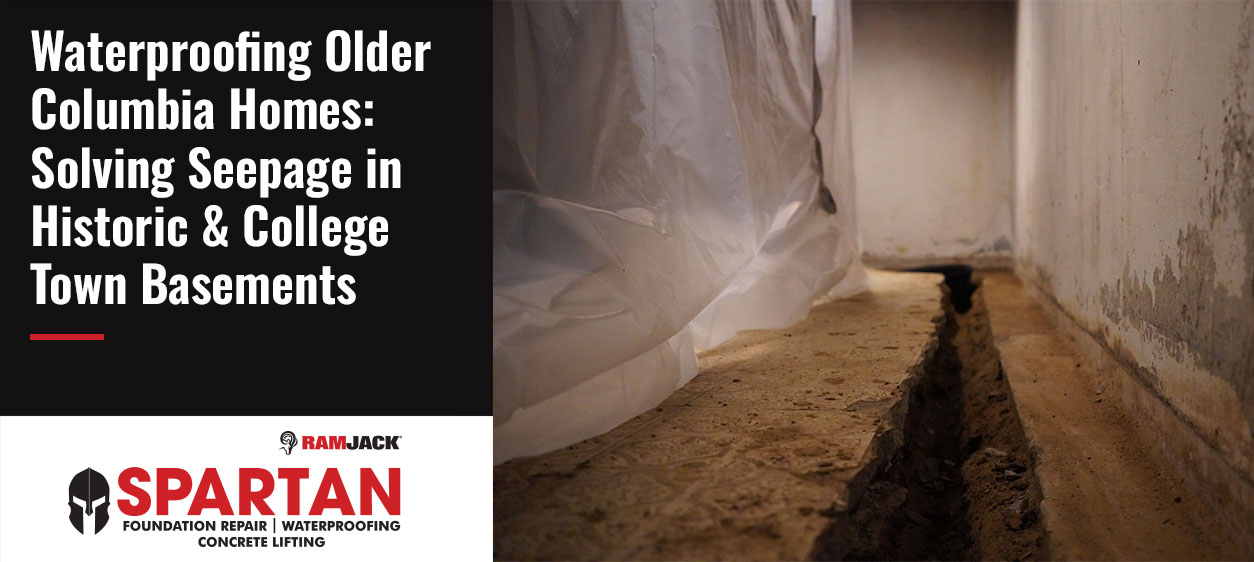
Older Columbia homes need a different approach to waterproofing than modern basements require. Historic properties and college town rentals throughout Columbia, Missouri, face distinct challenges rooted in their original construction. Stone foundations, fieldstone walls and century-old drainage systems weren’t designed to meet today’s waterproofing standards. So basement seepage in these older structures often enters through deteriorating mortar joints, irregular foundation walls and failed perimeter drainage. Columbia’s clay-heavy soil compounds the issue as it expands when absorbing moisture and shrinks during dry periods. Spartan Ram Jack of Columbia specializes in historic home basement waterproofing in Columbia and addresses old home foundation water problems with solutions tailored to your property’s age and construction. This piece covers how to identify and prevent basement water intrusion in Columbia’s older housing stock.
Why Older Columbia Homes Leak Differently Than Modern Construction
Quick answer: Stone and brick foundations weren’t built to modern waterproofing standards
Homes in the United States were built on masonry foundations constructed of stone or brick before concrete became the preferred building material. These foundations lack the monolithic structure of modern poured concrete. Stone and brick foundations have numerous mortar joints that turn into pathways for basement water intrusion when they deteriorate. Modern construction has waterproofing membranes and perimeter drainage systems, but historic masonry foundations were designed to manage moisture through breathability rather than complete water exclusion.
What makes Columbia’s historic and college town housing stock unique
Columbia, Missouri’s older neighborhoods have homes built before widespread concrete foundation use became standard practice. The college town’s rental properties often feature century-old basements with original stone or brick foundation walls. These structures rest on foundations constructed when local builders used readily available fieldstone and followed construction practices that prioritized material availability over moisture management. Columbia Missouri clay soil compounds the challenge, since saturated soil expands and pushes against foundation walls. This stresses mortar joints and causes them to crack.
How fieldstone and rubble foundations were originally constructed
Fieldstone foundations consist of irregularly shaped stones stacked together, often with a slight taper at the base. Early builders held these stones together with lime-and-sand mortar, or sometimes dry-stacked them without mortar at all. Fieldstone foundations were designed as flexible systems that moved slightly with freeze-thaw cycles, unlike modern foundations that act as solid barriers. The stones used in foundation masonry are not porous and won’t admit water. Rubble foundations don’t rely on uniformity or engineered precision, though. Their strength comes from the skill of original builders who placed stones to form a stable base.
Why mortar joints and drainage systems fail over time
Mortar has a finite service life, between 25 and 50 years depending on material quality and exposure conditions. The soil surrounding the foundation gets oversaturated due to heavy rains or improper yard drainage. The soil absorbs water and expands, pushing against the foundation wall and causing masonry units to move inward. This movement stresses mortar joints and causes them to crack. Freeze-thaw cycling drives further deterioration, as water absorbed into mortar freezes and expands by nine percent. Repeated cycles break down the mortar’s internal structure until it crumbles at the joint surface.
Identifying Water Problems in Historic and Rental Basements
Common seepage entry points in stone and brick foundations
Water enters historic foundations through predictable weak points. The most common entry occurs where grade meets the foundation wall, since water travels the least resistant path and the worst masonry deterioration happens at or below grade level. Mortar joints separating from brick or stone create channels for groundwater penetration. The cove joint, where basement floors meet foundation walls, serves as another frequent entry point. Floor slabs were poured after walls were built and left a small gap. Window wells collect water when bottom drains clog with debris and allow moisture to seep through adjacent foundation sections.
Signs of water intrusion in older Columbia basements
Efflorescence appears as white, chalky powder on basement walls when water moves through masonry and evaporates. Mineral salt deposits are left behind. Water stains show as discolored patches or horizontal tide lines where moisture has wicked through foundation materials. A musty odor signals elevated humidity levels above 60 percent relative humidity. These conditions promote mold growth on organic materials. Foundation cracks allow substantial water penetration and require immediate attention, especially horizontal ones or those widening over time. Peeling paint and blistering surfaces occur when wet-dry cycles force moisture into porous substrates.
Seepage vs. condensation: telling them apart in an older home
Water seepage means groundwater enters through foundation cracks or porous concrete. It appears during or after rain in the same locations each time. Condensation forms when warm, humid air contacts cooler basement surfaces and turns water vapor into liquid droplets on pipes and walls. Seepage shows white chalky deposits and visible cracks. Moisture worsens during storms. Condensation appears more in summer months without visible entry points.
Why college town rental properties need special attention
Rental properties need regular moisture inspections, especially after heavy rainfall or between tenant turnovers. High humidity can cause condensation and promote mold growth and wood rot that cause structural damage. Moisture problems affect tenant health and can result in expensive repairs if left unaddressed.
Waterproofing Solutions for Older Columbia Foundations
How waterproofing approaches differ for historic foundations
Civil engineers prefer exterior excavation as their method of choice. The process digs around the foundation, installs perimeter drainage and applies waterproofing membranes. You don’t need to excavate to fix stone foundation waterproofing problems. Interior basement waterproofing systems in Columbia install with nowhere near as much disruption and at half the cost of exterior methods. Jackhammering the floor perimeter and placing drainage on a stone bed completes interior drainage in one or two days. Landscaping, patios and attached structures remain undamaged—exterior excavation would disturb all of them.
Interior drainage systems for stone and rubble foundations
Groundwater collects at perimeter drainage where foundation walls meet basement floors. The system has perforated pipe installed in gravel with filter fabric lining. Block and poured basements leak from bottom wall joints. Stone walls have irregular gaps in mortar joints that allow water entry from any below-grade point. Vapor barriers cover the foundation walls and collect seepage before it enters the basement. The barrier tucks into the drainage system and directs moisture to the sump basin.
What a basement assessment has for an older home
Professional inspections get into basement wall composition, existing sump pit locations and condition, water table height, perimeter drainage presence, gutter and downspout condition, soil height and slope at grade, original waterproofing materials if any, settlement around the perimeter and incoming underground utilities. This evaluation identifies the water intrusion cause before designing solutions.
Sealing and repointing deteriorating mortar joints
Repointing removes deteriorated mortar and replaces it with compatible material. Old mortar should be removed to a depth of 2 to 2.5 times the joint width to ensure proper bond. Brick joints require removing mortar to approximately 0.5 to 1 inch depth. Stone foundations with wide joints may need several inches of removal. Modern Portland cement on historic stone foundations traps moisture inside walls. Water is forced through stones and causes spalling. Lime mortar breathes. Trapped moisture escapes and keeps stones intact.
Sump pump installation in basements with irregular floors
Columbia sump pumps install in the lowest basement area where water accumulates naturally. Basement corners work well because they catch water flowing toward edges and have less traffic. The sump pit sits below floor level, connected to the perimeter drainage system. Irregular floors require accessible pump placement to maintain. Future access through removable panels or cabinets must be considered.
Protecting Your Historic or Rental Property From Future Seepage
What Columbia homeowners can do proactively
Proper grading directs water away from foundations on all sides and prevents pooling that saturates soil around basement walls. Downspouts should extend at least ten feet from the foundation to reduce hydrostatic pressure against stone and brick masonry. Gutters and downspouts need clearing of leaves and debris so water flows freely away from the structure. Outdoor areas that collect water during storms need checking. This includes patios and basement stairways to confirm adequate drainage. Basement walls should be inspected for efflorescence and crumbling mortar joints to address deterioration before it worsens.
Steps landlords should take between tenant turnovers
Moisture inspections should be scheduled between tenants, especially when you have heavy rainfall or extended occupancy periods. Mold growth and wood rot thrive in high humidity and compromise structural integrity if left unchecked. Walk the property perimeter to verify soil grading remains sloped away from foundations and that downspout extensions stay positioned correctly. Basement conditions should be documented with photos during move-out inspections to establish baseline moisture levels for incoming tenants.
When to call a foundation specialist
Active water intrusion needs immediate professional assessment. Delaying diagnosis typically results in larger and costlier repairs. Contact Spartan Ram Jack of Columbia, Missouri whenever you observe foundation cracks that have widened recently, water pooling in basement corners, or ongoing seepage despite exterior drainage improvements.
Conclusion
Waterproofing in Columbia needs solutions tailored to stone foundations and century-old construction methods. Modern approaches don’t deal very well with the unique challenges of fieldstone walls, deteriorated mortar joints, and Columbia Missouri clay soil conditions. Spartan Ram Jack of Columbia specializes in basement waterproofing for older homes and college town rentals. A basement assessment will identify water entry points and protect your property from further moisture damage. Contact us today to schedule your free estimate.