
Beneath Wichita’s neighborhoods sits a geological layer that’s been shifting for millions of years — and it hasn’t stopped just because there’s a house sitting on it now.
The Wellington Formation is the Permian-age geological layer of shale, clay, and gypsum-bearing rock that underlies much of the Wichita area. Its clay-rich composition absorbs and releases moisture readily, causing the ground to expand and contract in ways that put sustained stress on home foundations built on or near it. This piece explains what the Wellington Formation is, how its soil movement damages Wichita foundations, and how Spartan Ram Jack stabilizes homes affected by it.
Quick Answer: How the Wellington Formation Affects Foundations
The Wellington Formation is a Permian-age geological layer of shale, clay, and gypsum-bearing rock that underlies much of the Wichita area. Its clay-rich composition absorbs and releases moisture readily, causing the ground to expand and contract in cycles that stress home foundations over time. This repeated movement is a primary driver of foundation cracks, uneven floors, and bowing basement walls throughout the region, and the damage tends to worsen with each wet-dry cycle rather than resolve on its own.
What Is the Wellington Formation?
The Wellington Formation is a Permian-age sedimentary formation, roughly 260+ million years old, composed largely of shale, clay, and gypsum deposits. It underlies much of south-central Kansas, including the Wichita metro, and crops out along the low bluff forming the east wall of the Arkansas Valley near the city.
What makes this formation particularly relevant to foundations is its mineral composition. Unlike sandy or gravel-based soils, which drain and hold their shape fairly consistently, the Wellington Formation’s shale beds contain clay minerals — montmorillonite, smectite, and bentonite among them — that are highly reactive to moisture. This is what makes the soil “expansive” rather than stable.
What Makes Clay Soil “Expansive”?
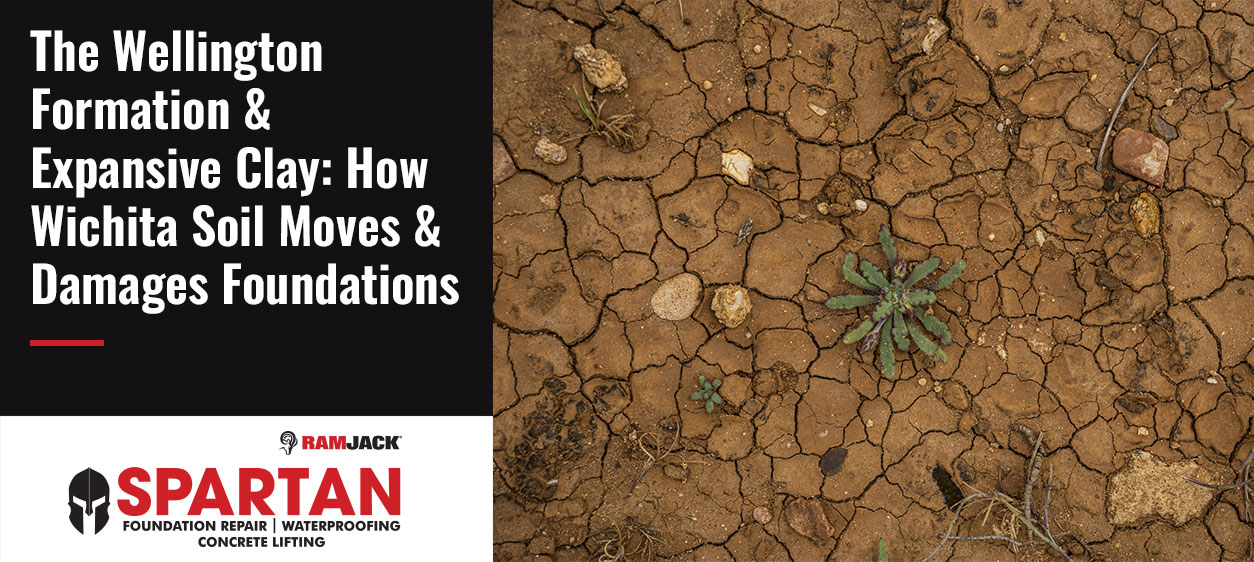
Expansive, or shrink-swell, clay contains minerals with a layered crystal structure that allows water molecules to wedge between microscopic clay plates. When the soil gets wet, it absorbs that water and increases in volume. When it dries out, it contracts significantly, sometimes leaving visible cracks in exposed soil.
This differs sharply from more stable soil types like sand or well-draining loam, which don’t undergo this kind of dramatic volume change. Some sources indicate pure montmorillonite can expand multiple times its original volume under lab conditions, and that Wellington Formation soil in its natural state commonly expands a substantial percentage when wetted. Gypsum content in some Wellington layers may add further moisture sensitivity, since gypsum itself can dissolve and redistribute with groundwater movement over time.
How This Soil Movement Damages Foundations
Soil movement beneath a foundation isn’t a one-time event — it’s a repeating cycle tied to the seasons.
During wet periods, soil absorbs moisture and swells, pushing upward against slab foundations and laterally against basement walls below grade.
During dry periods, the same soil loses moisture and contracts, pulling away from footings and leaving voids where solid support used to be.
Repeated over years, this cycle gradually weakens foundation walls, slabs, and footings. It also tends to move unevenly: soil at a foundation’s perimeter experiences more exposure to rainfall, irrigation, and evaporation than soil beneath the center of the structure, which stays more insulated and stable. That mismatch is what produces differential settlement — the perimeter heaves and settles seasonally while the interior holds steady, and the resulting angular distortion is what fractures foundations over time.
Seasonal Soil Movement Patterns in Wichita
| Season | Soil Behavior | Foundation Effect |
| Spring | Increased moisture, expansion | Heaving, upward pressure |
| Summer | Drying, contraction | Shrinkage, void formation |
| Fall | Variable moisture | Continued settling |
| Winter | Freeze-thaw cycling | Accelerated cracking |
Signs of Wellington Formation-Related Foundation Damage
- Stair-step cracks in brick or block foundations
- Diagonal cracks radiating from window and door corners
- Horizontal cracks or bowing in basement walls
- Sloping or uneven floors
- Sticking doors and windows that won’t latch properly
- Gaps between walls and ceilings, or around window and door frames
These signs often start small — a hairline crack, a door that sticks only in humid weather — and widen with each wet-dry cycle. Left unaddressed, years of repeated expansion and contraction can compromise structural integrity.
Why Drainage and Grading Matter So Much on Expansive Soil
Consistent, controlled soil moisture is far easier on a foundation than dramatic wet-dry swings, and poor drainage is what creates those extremes. A few practices make a measurable difference:
- Grading: Soil should slope away from the foundation, directing water outward rather than letting it pool against the wall.
- Downspouts: Discharge points should be extended well away from the foundation perimeter rather than dumping water right at the base.
- Subsurface drainage: French drains or similar systems can intercept groundwater before it reaches the foundation.
- Moisture consistency: In prolonged dry stretches, some homeowners use soaker hoses near (not against) the foundation to reduce extreme contraction — this is a maintenance habit worth discussing with a professional rather than a one-size-fits-all rule, since over-watering has its own risks.
How Foundation Repair Works on Expansive Clay Soil
When damage exceeds what moisture management alone can address, foundation stabilization typically relies on deep pier systems:
- Push piers are hydraulically driven through the unstable, reactive clay layer down to more stable bearing soil or bedrock.
- Helical piers screw into the ground and can work across a range of soil conditions.
Both systems share the same goal: bypass the Wellington Formation’s active shrink-swell zone and transfer the home’s weight to stable strata below it, where seasonal moisture swings no longer affect support.
The Foundation Assessment and Repair Process
- Foundation inspection and documentation of existing cracks or movement
- Soil and drainage assessment around the home
- Pier design and placement plan based on depth to stable soil
- Pier installation and foundation stabilization
- Drainage and grading recommendations to reduce future movement
- Final inspection and a monitoring plan going forward
When to Get a Geotechnical or Soils Report
A geotechnical or soils report is generally worth the investment for new construction, home additions, or homes showing significant, unexplained foundation movement. A visual inspection can identify symptoms, but a soils report reveals what’s actually happening below the surface — soil composition, depth to stable bearing strata, and the soil’s expansion index. That data is what informs accurate pier depth and repair design, rather than relying on general regional assumptions about the Wellington Formation.
Cost Factors for Wichita Homeowners
- Number and depth of piers required
- Severity and extent of existing foundation damage
- Scope of drainage correction needed alongside stabilization
- Whether a soils/geotechnical report is recommended before repair
How Spartan Ram Jack Addresses Wellington Formation Soil Conditions
Spartan Ram Jack brings local experience with Wichita-area expansive clay and the specific foundation behavior it causes. Every assessment starts with a free inspection, followed by a stabilization plan suited to the home’s soil conditions and the severity of existing damage — not a generic repair template.
Schedule your free foundation assessment in Wichita today, and find out what’s really moving beneath your home before the damage spreads further.
FAQs
What is the Wellington Formation?
The Wellington Formation is a Permian-age geological layer of shale, clay, and gypsum-bearing rock that underlies much of south-central Kansas, including the Wichita metro area.
Why is Wichita soil prone to foundation problems?
The Wellington Formation’s shale layers contain expansive clay minerals that absorb and release moisture readily, causing the ground to swell and shrink in cycles that stress home foundations over time.
Can expansive soil damage be prevented?
Soil composition can’t be changed, but consistent moisture management — proper grading, downspout extensions, and drainage correction — significantly reduces the extreme wet-dry swings that drive the worst movement.
How much does foundation repair cost in Wichita?
Cost depends on the number of piers needed, damage severity, and drainage work required.
Do all Wichita homes sit on the Wellington Formation?
The formation’s extent varies by specific location within the metro, so a site-specific assessment is the only reliable way to confirm conditions for an individual property.
The Wellington Formation expansive clay that Wichita sits on ranks among the country’s most damaging geologic hazards. It causes billions of dollars in structural damage annually, more than floods, hurricanes and earthquakes combined in most years. This Permian-age clay-rich soil can exert swelling pressures exceeding 20,000 to 30,000 pounds per square foot, far more than enough to lift and crack your home. Wichita expansive soil foundation damage then appears as diagonal foundation cracks, uneven settlement and bowing basement walls throughout the region. You can save thousands in foundation repair Wichita costs when you understand how clay soil foundation movement works and recognize the signs early. This piece explains the Wellington Formation’s unique behavior and how Spartan Ram Jack stabilizes homes built on Kansas’s shrink-swell soil.
Contact Spartan Ram Jack Today
The Wellington Formation soil beneath your Wichita home will continue its shrink-swell cycle with every season. Then early detection and professional intervention protect your investment from escalating structural damage. Consistent moisture management reduces soil movement. But foundation settlement in Wichita requires stabilization through deep pier systems. Spartan Ram Jack bypasses the expansive clay soil in Kansas and anchors your foundation to bedrock. Schedule your foundation inspection in Wichita today and stop the damage before it spreads.